At the Faculty, academic studies are conducted on the basis of approved, i.e. accredited study programmes for acquiring higher education. Academic study programmes enable students to develop and apply scientific and professional achievements.
Studies at the Faculty are conducted in the Serbian language. Studies at the Faculty may also be conducted in the English language if there is sufficient interest.
For enrolment, in a study programme, a candidate must have proficiency in the language in which the programme is delivered. Language proficiency is assessed in the manner and procedure prescribed by the Dean through a general act. Tuition fees are payable for studies conducted in English, in accordance with the contract concluded between the student and the Faculty.
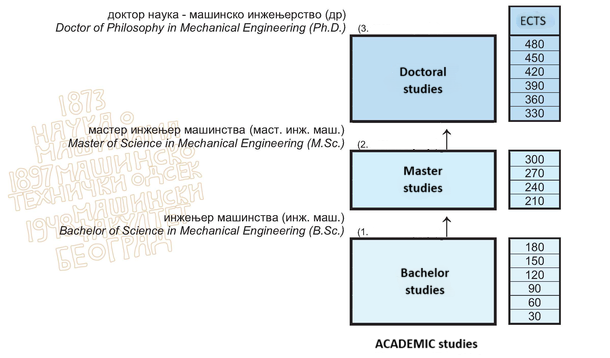
The studies conducted since 1 October 2005 at the Faculty of Mechanical Engineering, University of Belgrade are:
Each course within a study programme is expressed in ECTS credits, and the scope of studies is expressed as the total sum of ECTS credits.
A total of 60 ECTS credits corresponds to the average overall student workload equivalent to a 40-hour working week during one academic year.
The total student workload consists of:
A student takes an exam immediately after the completion of teaching in that course, and no later than before the start of teaching of that course in the following academic year, in one of the languages in which the teaching was conducted. The exam is unified and can be taken orally, in written and oral form, in written form, or practically. A student can take the exam if he/she has fulfilled all prescribed pre-exam obligations defined by the teaching plan and has met other requirements for taking the exam stipulated by the study programme, the Statute, and other general acts of the Faculty.
Exams are public, and a student has the right, if taking an oral exam, to request the presence of the public. A student with a disability has the right to take the exam in a manner adapted to their abilities, in accordance with the general act of the Faculty.
The manner of taking exams, the time and schedule of their administration, postponement of exams, withdrawal from exams, record-keeping procedures, as well as other issues related to exams and grading, are regulated in more detail by the general act of the Faculty, in accordance with the general act of the University.
Student performance in exams is expressed by grades:
10 – excellent; 9 – outstanding; 8 – very good; 7 – good; 6 – sufficient;

Faculty of Mechanical Engineering
University of Belgrade
Kraljice Marije 16
11120 Belgrade 35
Phone: (+381 11) 3302-200
Fax: (+381 11) 3370-364