
Faculty of Mechanical Engineering Partner in the Horizon Europe Project KINETIKA for Cultural Heritage Preservation
The Faculty of Mechanical Engineering at the University of Belgrade is one of 18 partners from 11 European countries participating in the KINETIKA project, which is being implemented under the Horizon Europe programme (Call: HORIZON-CL2-2024-HERITAGE-ECCCH-01, Project No. 101233379).
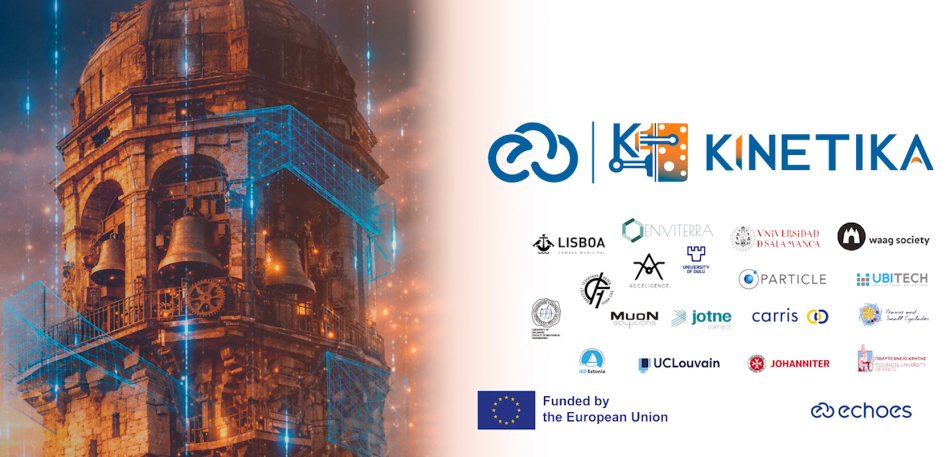
The project is focused on the preservation of dynamic cultural heritage, namely objects and structures that contain mechanical or movable elements. Particular attention is given to heritage assets whose mechanical systems are affected by ageing, operational loads, and degradation, making traditional documentation methods insufficient for fully understanding, monitoring, and analysing their behaviour over time.
The main objective of the project is to develop a modular framework for creating 4D Digital Twins through the application of Industry 4.0 technologies. This approach enables the integration of data on geometry, motion, structural behaviour, and time-dependent changes, creating a detailed digital representation of complex mechanical systems within cultural heritage assets. In this way, heritage objects can not only be documented but also continuously monitored, analysed, and simulated, representing a significant advancement over conventional conservation and research methods.
The developed framework will be validated through case studies on full-scale sites across Europe, including clock towers, industrial heritage sites, historic elevators, and masonry structures with movable elements. The results of these pilot projects are expected to demonstrate the applicability of the solution to various types of cultural heritage and contribute to the development of a pan-European digital infrastructure for cultural heritage, as well as its integration with the European Collaborative Cloud for Cultural Heritage (ECCCH).
The KINETIKA project started in January 2026 and will run until the end of 2028. The project consortium brings together 18 institutions from 11 European countries, including the Faculty of Mechanical Engineering in Belgrade. The project coordinator is Prof. Diego González-Aguilera from the University of Salamanca (Spain).
The Faculty of Mechanical Engineering is represented by the team from the Department of Theory of Machines and Mechanisms, consisting of Dr Branislav Popkonstantinović, full professor and Dr Miša Stojićević, associate professor. The research activities of the team members cover the fields of mechanism kinematics and dynamics, linkage system analysis, and the application of advanced computational tools, including computer graphics and physics-based simulations.
Within the KINETIKA project, the Faculty’s team will be responsible for the modelling, simulation, and analysis of the mechanical behaviour of cultural heritage assets with moving elements. By integrating kinematic and dynamic models, sensor-collected data, and advanced visual simulations, the researchers will contribute to the development of functional digital twins that will enable more reliable predictive analyses, interactive presentation, and a better understanding of the operation of complex mechanical systems in cultural heritage.